5 Steps to Calm Emergency Preparedness for Families
Last Updated: October 26, 2026
Quick Summary
Emergency preparedness for families works best when you build it slowly, without panic, by assessing your local hazards, creating a communication plan, talking to kids calmly, assembling practical supplies, and practicing your plan together.
- Only 15% of households felt very prepared for natural disasters according to the 2026 United Way Preparedness Survey.
- A 72-hour emergency kit should include one gallon of water per person per day, non-perishable food, flashlight, first-aid kit, and important documents.
- Teach children regulation techniques like box breathing and the 5-4-3-2-1 grounding scan during calm moments so they're available during stress.
- Run family drills at least twice a year and debrief afterward to identify what went smoothly and what needs adjustment.
- Review and update your emergency plan and kit twice yearly, checking expiration dates and confirming all family members remember the out-of-area contact and meeting place.
Table of Contents
- Why Calm Emergency Preparedness Matters for Your Household
- Step 1: Assess Your Local Hazards and Build a Family Emergency Plan Checklist
- Step 2: Create a Family Emergency Communication Plan That Works
- Step 3: Prepare an Emergency Plan for Kids Without Causing Anxiety
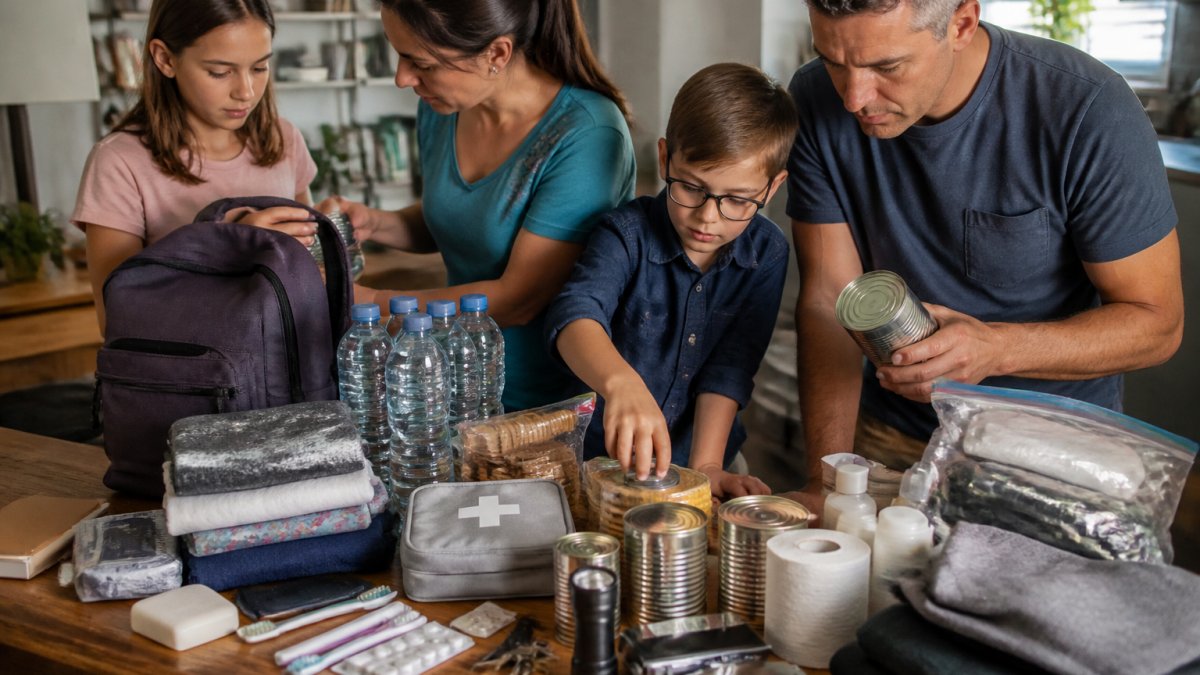
- Step 4: Assemble Your Family Emergency Kit Checklist
- Step 5: Practice Your Plan and Stay Prepared
- Start Your Household Readiness Assessment Today
- Frequently Asked Questions
Why Calm Emergency Preparedness Matters for Your Household
Most families wait until disaster strikes to think about being prepared.
According to the United Way's 2026 Preparedness Survey, only 15% of respondents felt very prepared for a natural disaster. That means 85% of households are vulnerable to preventable harm.
These numbers reflect confusion, not laziness.
Calm emergency preparedness for families starts with a different mindset: you're not trying to survive the apocalypse.
Step 1: Assess Your Local Hazards and Build a Family Emergency Plan Checklist
Your emergency plan means nothing if it doesn't match the disasters you actually face. A hurricane plan doesn't help someone in earthquake country.
Start by identifying which hazards are real for your location. Check your local government emergency management office or the Ready.gov planning resources for guidance on alerts, shelter options, and evacuation routes specific to your area.
Once you know your hazards, build a written family emergency plan. This plan answers these core questions:
- Where will we go if we need to evacuate?
- How will we communicate if phones don't work?
- Who picks up the kids if both parents are at work?
A written plan isn't just practical, it reduces anxiety. Use a family emergency plan template to document your decisions, then print it, share it, and post a copy in your home.
Step 2: Create a Family Emergency Communication Plan That Works
When disaster strikes, cell networks often fail. Text messages sometimes get through when calls don't.
Identify an out-of-area contact who can relay messages between separated family members.
For communication during an emergency, consider these options:
- A charged phone with a backup battery or charger
- A battery-powered or hand-crank radio to receive alerts
- A whistle or bell to signal family members nearby
The American Red Cross guidance on family preparedness emphasizes discussing your plan in advance. Talking it through reduces fear, especially for younger children.
For households with limited cell service or frequent outages, reference what to do when cell service is down or congested for practical workarounds that actually work.
Step 3: Prepare an Emergency Plan for Kids Without Causing Anxiety
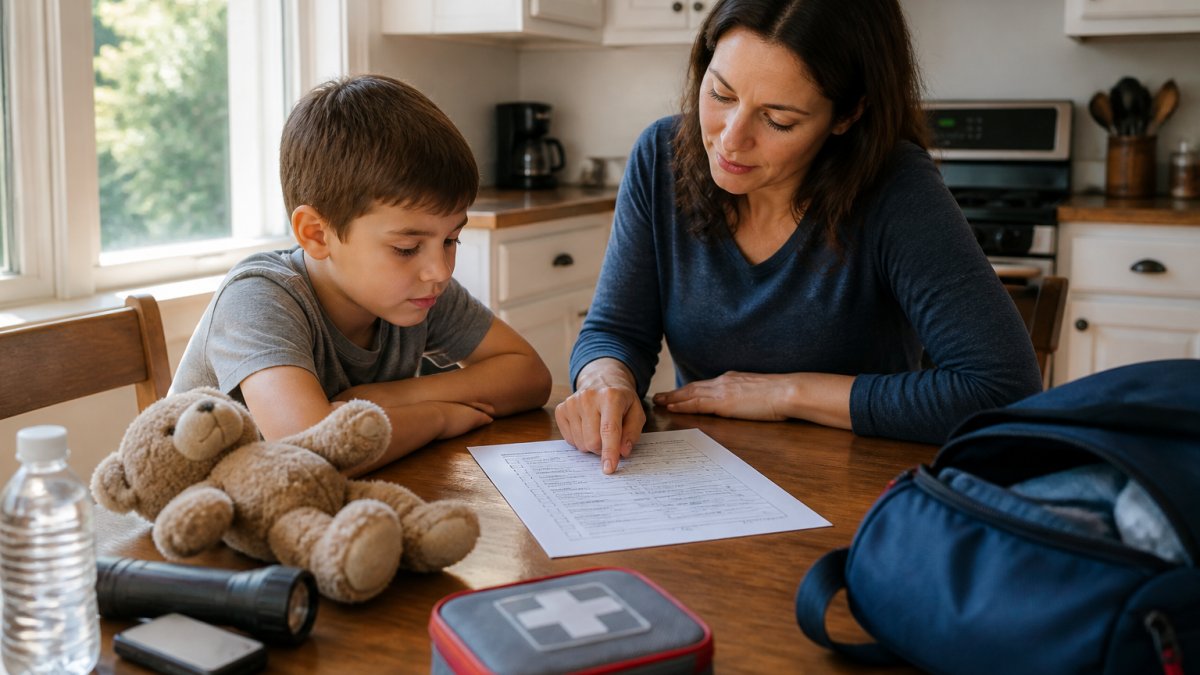
Kids pick up on panic. If you approach emergency planning like you're terrified, they'll be terrified too. Calm, matter-of-fact planning teaches kids that preparation is normal and manageable.
Start with a script, not a speech
Short, concrete sentences work better than long explanations. A pattern many parents find effective is name the plan, name the feeling, name the next step:
- "We're making a family plan so we know what to do if the power goes out. That's what the flashlight and the snack box are for."
- "It's okay to feel nervous when we talk about this. Being prepared is how we take care of those nerves."
- "If you ever feel scared, you come find me or another trusted adult. That's your job. My job is to keep us safe."
Avoid phrases like "when disaster strikes" or "if something terrible happens." Use "if the power goes out," "if we have to leave the house for a night," or "if a big storm comes." Specific, bounded scenarios feel manageable; vague catastrophe language does not.
Match the message to the age band
Children process risk differently at each stage. A rough guide:
- Ages 3-5: Keep it to one idea, "If we have to leave, you hold my hand and we go to the car." Practice the hand-holding and the walk to the car. No disaster vocabulary.
- Ages 6-9: Introduce the meeting place, the out-of-area contact, and what a safe room looks like. Let them help pack a small bag with a comfort item. Answer questions honestly but briefly.
- Ages 10-13: Involve them in the plan. Let them choose a role, checking the flashlight batteries, carrying the pet carrier, reading the contact card. Responsibility reduces fear at this age.
Watch for the signs that a child is overwhelmed
A calm conversation can still land hard. Watch for a child who goes quiet, changes the subject, repeats the same question, or wants to leave the room. Those are signals to pause, not push. Say: "We can stop here. We've done enough for today. The plan is in the folder whenever you want to look at it." Revisit in short sessions, ten minutes at a time over a few weeks, rather than one long talk; repetition in small doses builds familiarity without dread.
Practice together, and make it feel like a win
Run a simple drill: "The power is out. What do we do?" Let kids think through the answer, praise them for remembering, and make it feel like a game, not a test.
Include comfort items in your emergency kit: a favorite stuffed animal, a book, a game, a family photo. These aren't frivolous, they're tools for emotional regulation when stress is high.
What not to do
- Don't show young children news footage of disasters as a way to "prepare" them. It raises fear without teaching a skill.
- Don't promise that nothing bad will ever happen. Children trust adults who are honest. Promise instead that you have a plan and that they will not be alone.
- Don't make the plan a secret. A plan a child doesn't know about is a plan that won't work.
The goal isn't a child who never worries. It's a child who knows what to do when they do worry, and who knows where to find the adult who will help.
Step 4: Assemble Your Family Emergency Kit Checklist
An emergency kit keeps your family functional when normal systems fail.
Start with these essentials:
- Drinking water (1 gallon per person per day for drinking and basic hygiene)
- Non-perishable food (items your family actually eats, not survival rations)
- Flashlight and extra batteries
According to the United Way 2026 Preparedness Survey, 65% of families haven't assembled an emergency kit.
Use the bug-out bag build checklist to create a portable go-bag for evacuation scenarios.
For households with kids, elderly members, or pets, customize your kit. Build a first aid kit tailored to your household that accounts for allergies, medications, and specific health needs.
Store your kit in an accessible, clearly labeled location, a closet, cabinet, or garage shelf.
A basic 72-hour emergency kit should include these essential items.
| Item | Amount | Purpose |
|---|---|---|
| Drinking water | 1 gallon per person per day | Drinking and basic hygiene |
| Non-perishable food | 72-hour supply | Items your family actually eats |
| Flashlight and batteries | One set plus extras | Light without power |
| First-aid kit and medications | Full supply | Medical needs and allergies |
| Important documents | Complete set | Waterproof container |
| Blankets or sleeping bags | One per person | Warmth without power |
| Basic tools | Knife, wrench, duct tape | Emergency repairs |
| Cash | Small bills | Transactions when cards fail |
Step 5: Practice Your Plan and Stay Prepared
A plan you've never tested is just a piece of paper. But practice is only half of staying ready. The other half is staying calm when the plan is actually being used, a drill in daylight feels very different from a real outage at 2 a.m.
Run drills that build calm, not just competence
Run a family drill at least twice a year. Pick a scenario: "The power is out and we need to leave the house in 30 minutes." Walk through your plan step by step. Did everyone know where to go? Did you find the flashlight? Did the communication plan work? Families who drill successfully narrate calm out loud: "Okay, I'm getting the flashlight.
Use simple regulation techniques before, during, and after
Emotional regulation is a skill that improves with practice. Teach these to every family member, including yourself:
- Box breathing: Inhale for four counts, hold for four, exhale for four, hold for four. Repeat four times. It's simple enough for a school-age child to learn and effective enough for an adult in a stressful moment.
- The 5-4-3-2-1 grounding scan: Name five things you can see, four you can touch, three you can hear, two you can smell, one you can taste. This pulls attention out of the spiral and back into the room.
- The hand-on-chest reset: Place one hand on your chest and one on your belly. Take three slow breaths. Say out loud, "I'm safe right now. The plan is working." This works for adults and children alike.
Practice these techniques during calm moments, not just drills. A technique learned in peace is available in stress.
Reassure in the moment, and afterward
During an emergency, short reassurance beats long explanation. "I'm here. We have a plan. We're doing it now." Repeat as needed. Children may ask the same question many times; answer it the same way each time, consistency is calming. After the event, even a brief power outage, check in: ask what each person noticed and how they felt, and name what went well.
Keep the plan and the calm current
Keep your plan updated. If someone changes jobs, update the out-of-area contact.
Review your kit twice a year: check expiration dates on food and medications, replace batteries, top up water.
For deeper guidance on testing and refining your plan, learn how to build a family disaster plan that works.
Track your progress. FlintReady's readiness diagnostic gives you a baseline score and shows which gaps matter most.
Start Your Household Readiness Assessment Today
Emergency preparedness doesn't require expensive gear or endless research. It requires a clear plan, practical supplies, and confidence that you've thought through your family's specific needs.
FlintReady's 3-minute readiness diagnostic identifies your biggest gaps and shows you exactly which fixes deliver the most protection for your household. You get a prioritized action list, not a generic checklist.
Start your assessment today and take control of your family's safety.
Frequently Asked Questions
How do you make an emergency plan for your family?
Start by identifying local hazards specific to your area, then assign meeting places, establish communication methods, and document out-of-area contacts. Write down responsibilities for each family member, create a household emergency kit, and practice your plan twice yearly. FlintReady's three-minute readiness diagnostic helps identify gaps and prioritizes what to address first, so you build your plan step-by-step rather than feeling overwhelmed.
What should a family emergency communication plan include?
Your family emergency communication plan should list an out-of-area contact person, phone numbers for all family members, workplace locations, and meeting places if separated. Include text-based communication methods (texts often work when calls don't), a designated meeting spot outside your home, and instructions for reuniting if family members are apart. Write this down and give copies to each family member so everyone knows the protocol without needing to search for information during a crisis.
How can I prepare children for emergencies without frightening them?
Use calm, age-appropriate language focused on what your family will do, not what might happen. Frame preparedness as a smart plan, like having a fire drill at school. Practice simple skills like knowing how to call 911 or reach an out-of-area contact. Involve kids in assembling the emergency kit so they feel part of the solution. Research shows discussing emergency preparation ahead of time reduces fear in younger children when they understand the family has a plan in place.
What supplies should a family keep at home for an emergency?
Your family emergency kit checklist should include drinking water (one litre per person per day for several days), non-perishable food, a first-aid kit, medications and medical supplies, flashlights with extra batteries, important documents, identification, pet food and carriers if applicable, and comfort items. Store items in an accessible location. For apartment dwellers or those with limited space, FlintReady's guides focus on practical, space-efficient storage solutions rather than impractical bulk supplies.
