Which Water Filter Works Without Electricity in an Emergency?
Quick Summary
The best emergency water filter for use without electricity is a gravity-fed or hand-pumped unit that needs no batteries, setup, or charger. The LifeStraw Personal is reported to filter 4,000 liters for about $15. Filters remove bacteria and protozoa but not viruses, so disinfect water from unknown sources.
- Gravity filters run on water weight and need no electricity, but take up counter space.
- The LifeStraw Personal is reported to filter 4,000 liters for about $15 with no batteries or setup.
- Filters with 0.1-micron membranes remove bacteria and protozoa but not viruses.
- For unknown sources, filter first, then boil or chemically disinfect the water.
- Rotate stored tap water about every six months and label containers with fill dates.
Table of Contents
- Why Power-Free Filtration Matters in an Outage
- Best Gravity Water Filter for Emergencies
- Portable Filters for Camping, Backpacking, and Preparedness
- Non-Electric Water Purifier for Home Use
- Filtration Versus Disinfection: What a Filter Does Not Remove
- Water Filter Lifespan, Capacity, and How to Store Emergency Drinking Water
- Choosing Your Filter and Building Your Water Plan
- Frequently Asked Questions
Why Power-Free Filtration Matters in an Outage
Last Updated: November 1, 2026
Emergency water filters are the simplest way to keep drinking water safe when the power goes out and the tap stops being reliable.
The LifeStraw Personal is reported to filter 4,000 liters of water for about $15, with no power, batteries, or setup required (PowerOutage.us emergency water filter comparison). That combination of low cost and zero dependence on electricity is why it appears on so many emergency lists.
Power-free filtration matters because a water filter is only useful if it is available in the moment. A filter that needs batteries, a pump that needs power, or a system that needs installation can fail at exactly the wrong time.
A gravity filter is also appealing for households because it processes larger volumes with little effort and no electricity (Protocol Survival guide to gravity water filters).
Best Gravity Water Filter for Emergencies
Gravity-fed systems are usually the strongest choice for a household backup. You fill an upper reservoir, and water passes through the filter element under its own weight. There are no moving parts to break and no electricity to find.
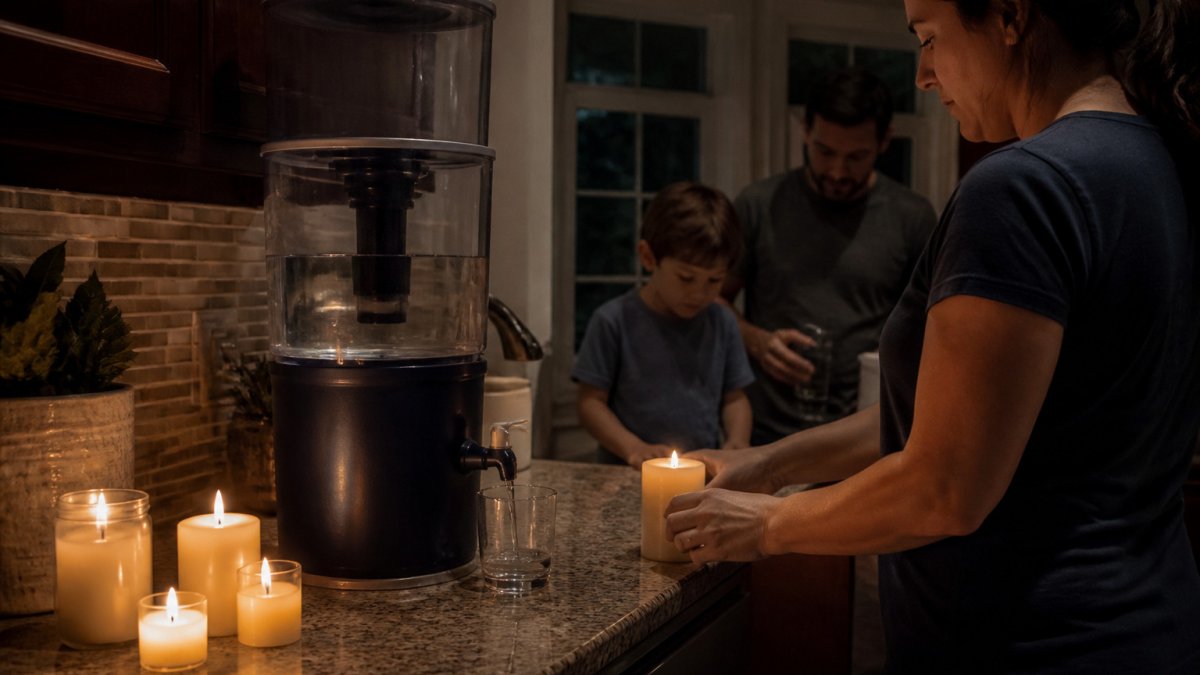
Gravity filters are presented as a no-electricity option for household emergency water treatment, and they handle more volume than most personal straws (Protocol Survival gravity filter comparison). The trade-off is size: these systems take up counter space, which matters in smaller homes.
For uncertain water sources, emergency-preparedness guidance recommends pairing a gravity filter with a chemical disinfection step (Frizzlife guidance on gravity filters and disinfection). A filter alone does not address every contaminant, a point we return to later in this guide.
Gravity Systems Worth Investigating: Outback and Alexapure Pro
The Outback Emergency Water System is a gravity-fed unit that needs no electricity. Check the current cost and specifications before buying.
The Alexapure Pro is a gravity-fed filter. Compare its current pricing and replacement-element costs with other gravity systems before deciding.
Portable Filters for Camping, Backpacking, and Preparedness
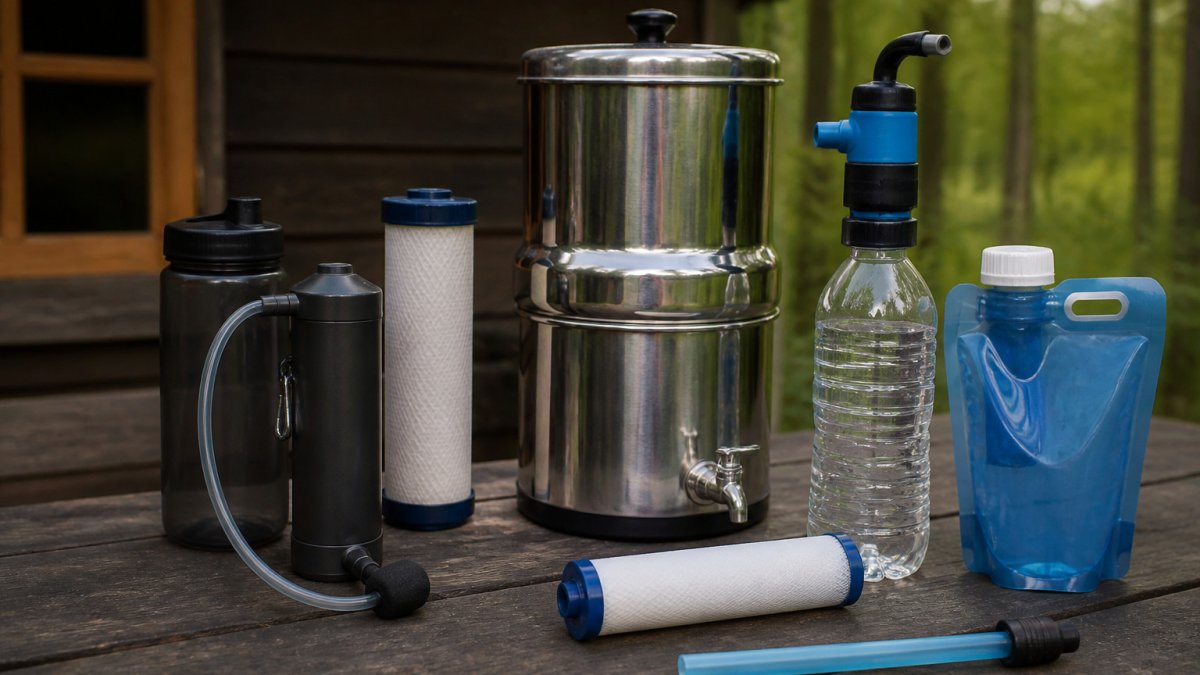
Portable filters are the lightest and most packable option for emergency water treatment. They suit people who may need to move, camp, or carry water on foot, and they work well as a second filter in a household kit when a gravity system is too bulky to relocate. The trade-off is capacity: most portable filters are designed for individual drinking water rather than household supply, so output rates and cartridge lifespans matter more than they do on a countertop gravity unit.
Portable filters generally fall into three form factors: squeeze filters (a soft bottle or pouch that you squeeze through a hollow-fiber cartridge), pump filters (a hand pump that pushes water through the element), and straw-style filters (a personal straw you drink through directly). Each has a different failure mode and a different role in an emergency plan.
Squeeze Filters: Sawyer Squeeze and Sawyer Mini
The Sawyer Squeeze and Sawyer Mini are squeeze-style filters. Both use a hollow-fiber membrane rated at 0.1 micron, which is generally small enough to remove bacteria and protozoan cysts but not small enough to reliably remove viruses. That distinction matters for emergency planning and is covered in the filtration-versus-disinfection section below.
Squeeze filters of this type can typically be backflushed, which extends cartridge life when source water is cloudy. Pre-filtering through a cloth or coffee filter before squeezing is a useful extra step on turbid water.
Straw Filters: LifeStraw Personal
The LifeStraw Personal is a personal straw-style filter that needs no setup, batteries, or pumping. It is rated to filter up to 4,000 liters. Its main limit is that it is a personal filter: you drink directly through the straw, so it is best for individual drinking water rather than filling containers for a household. It also does not remove viruses or dissolved chemicals, so it should be paired with disinfection when the source is unknown.
Pump Filters: Katadyn and MSR
Pump filters use a hand pump to push water through a ceramic or hollow-fiber element. They are generally heavier than squeeze filters but can process larger volumes and fill containers directly, which makes them useful for a small group or a household that needs to treat water for cooking as well as drinking. Pump filters require maintenance, ceramic elements need scrubbing, and hollow-fiber elements need backflushing, so keep the cleaning tool with the filter. Pump-style purifiers such as the MSR Guardian are a different category from filters. Confirm the power requirements and current price of any specific model before relying on it.
Bottle Filters: Waterdrop and Built-In Bottle Systems
Some manufacturers offer both portable bottle filters and undersink systems. Undersink systems need a plumbed connection and are not portable options, so they should not be counted as emergency filters. Confirm the operating requirements and rated contaminant list of any specific portable model before buying.
What to Check Before Buying a Portable Filter
- Micron rating and technology. A 0.1-micron hollow-fiber membrane removes bacteria and protozoa but not viruses. A purifier that claims virus removal should state the standard it was tested to (for example, NSF P231 or US EPA guidance).
- Rated volume and replacement cost. A 4,000-liter cartridge sounds generous until you divide it by a household's daily drinking water needs. Check the replacement-element price and availability.
- Backflush and cleaning method. Filters that cannot be cleaned will clog on cloudy source water. Confirm the cleaning tool is included.
- Thread and container compatibility. Squeeze filters that accept standard bottle threads are more flexible in an emergency than proprietary systems.
- Weight and packability. A pump filter that stays in the closet is worse than a straw filter that travels in the go-bag.
Non-Electric Water Purifier for Home Use
A purifier differs from a filter. Filters remove particles and some microorganisms, while purifiers are designed to remove a wider range of contaminants. LifeStraw distinguishes these categories and describes its Escape High-Flow Pressurized Water Purifier as meeting US EPA and NSF P231 drinking-water standards (LifeStraw filtration versus purification guide). The supplied results did not include the underlying test details, so verify any standard before relying on it.
Confirm the power requirements and price of any purifier before purchase.
Filtration Versus Disinfection: What a Filter Does Not Remove
Many people assume any water filter makes water safe. That is not accurate, and the distinction is the single most important point for emergency planning. Filtration and disinfection are different processes that address different threats, and a filter alone may leave you exposed to viruses or dissolved chemicals depending on its design and the source water.
What Filtration Removes
Mechanical filtration passes water through a membrane or element with a rated pore size. A 0.1-micron hollow-fiber membrane, the rating used by the Sawyer Squeeze, Sawyer Mini, and LifeStraw Personal, is small enough to remove bacteria (typically 0.2-2 microns) and protozoan cysts such as Giardia and Cryptosporidium (typically 3-8 microns). It is not small enough to reliably remove viruses, which are typically 0.02-0.3 microns. Filters also remove sediment and particulate matter, which is why pre-filtering cloudy water extends cartridge life.
What Filtration Does Not Remove
- Viruses. Norovirus, rotavirus, and hepatitis A are smaller than the pore size of most hollow-fiber filters. A filter rated at 0.1 micron is not a virus barrier.
- Dissolved chemicals. Pesticides, herbicides, heavy metals, and some industrial chemicals pass through mechanical filters unless the filter includes an activated-carbon or adsorption stage.
- Dissolved salts and minerals. Filters do not desalinate water. If the source is brackish or contaminated with saltwater, filtration is not the right tool.
What Disinfection Removes
Disinfection, boiling, chemical treatment, or UV, kills or inactivates microorganisms, including viruses, that pass through a filter. Boiling is the most reliable method: the CDC recommends bringing water to a rolling boil for at least one minute (three minutes at higher altitudes) to kill bacteria, viruses, and protozoa. Chemical disinfection with unscented household chlorine bleach or chlorine dioxide tablets is effective against bacteria and viruses but less reliable against Cryptosporidium, which is resistant to chlorine. UV treatment is effective against bacteria, viruses, and protozoa but requires clear water and a power source, which makes it a poor fit for a no-electricity emergency.
When to Pair Filtration With Disinfection
A common pattern in emergency-preparedness guidance is to pair a filter with a chemical disinfection step when the source is uncertain. Use filtration first to remove sediment and protozoa, then disinfect to address viruses. For a known clean source such as municipal tap water during a boil-water advisory, a filter alone may be sufficient for sediment and protozoa, but follow the advisory's guidance on boiling. For an unknown or surface source, a stream, a roof-catchment tank, or floodwater, assume viruses are present and disinfect after filtering.
A filter does not remove every threat, so the table below shows which contaminants filtration misses and which step covers them.
| Threat | Filter removes it? | What covers the gap |
|---|---|---|
| Bacteria | Yes, typically 0.2-2 microns | Filter alone is often enough |
| Protozoa (Giardia, Cryptosporidium) | Yes, typically 3-8 microns | Filter; boil for Cryptosporidium |
| Viruses (norovirus, rotavirus, hepatitis A) | No, smaller than 0.1 micron pores | Boil or chemical disinfection |
| Dissolved chemicals (pesticides, heavy metals) | No, unless carbon stage included | Activated-carbon stage or different source |
| Dissolved salts | No | Filtration is not the right tool |
Water Filter Lifespan, Capacity, and How to Store Emergency Drinking Water
Filter capacity is usually rated in liters, and it drops as the element clogs with sediment. Check the rated volume and replace the element on schedule. Cloudy source water shortens filter life, so pre-filter sediment with a cloth when possible.
For water you store yourself, the CDC recommends food-grade containers, rotating stored tap water about every six months, and labeling each container with its fill date (CDC guidance on emergency water storage). Store containers in a cool, dark place away from chemicals.
Choosing Your Filter and Building Your Water Plan
Start with your situation. A household with a gravity filter, a few personal straws, and a stored-water supply covers most emergency scenarios. An apartment dweller may prefer a compact personal filter plus a modest storage supply.
Match the filter to the threat. For a power outage with a known clean source, a gravity or personal filter is usually sufficient. For an unknown or contaminated source, combine filtration with disinfection.
Use the FlintReady readiness diagnostic to see where your water plan has gaps, then prioritize the fixes that match your household size, space, and budget.
Frequently Asked Questions
What is the best water filter for emergencies without electricity?
Gravity-fed systems are usually the strongest choice for households because they process larger volumes with no electricity, batteries or pumping. Portable personal filters such as the LifeStraw Personal are a useful backup for individuals. Check each product's stated contaminant range and capacity against your needs, because the research available for this guide does not confirm performance for every water source. Pair any filter with a disinfection method when the water source is uncertain.
Do water filters work during a power outage?
Yes, provided the filter is gravity-fed or manually operated. Gravity filters rely on water height rather than electricity, and personal filters are squeezed or pumped by hand. Electric purifiers will not work during an outage. Confirm the operating method of any product before you rely on it in an emergency.
Can a water filter remove viruses from drinking water?
Not every filter can. Many portable filters are designed to remove bacteria and protozoa, but viruses are much smaller and require a purifier or a separate disinfection step such as chemical treatment or boiling. Read each product's specification for viral reduction rather than assuming it, and treat filtration and disinfection as different processes.
