7 Family Disaster Preparedness Training Resources That Work
Last Updated: November 8, 2026
Quick Summary
Family disaster preparedness training works best as a short, sequenced four-week curriculum with one-hour weekly sessions covering communication, kits, evacuation and shelter drills. Each session ends with a timed drill and a readiness check, so you fix the weakest link first. Free, fillable plan templates from Ready.gov and other recognized agencies give you the forms to start.
- Only 15% of survey respondents felt very prepared for a natural disaster, and 84% had never created or tested a household emergency plan.
- A family emergency plan template should capture meeting places, emergency contacts, evacuation routes and each member's roles.
- Run one drill per hazard per year and time each drill so you can compare results.
- Practice earthquake drop, cover and hold on for at least 60 seconds, and never run outside during shaking.
- Score your household on plan, kit, contacts and drills, then fix the biggest gap first.
Table of Contents
- Why Most Family Disaster Preparedness Training Fails Before It Starts
- Building Your Family Emergency Plan Template Step by Step
- What a Good Emergency Plan Example Looks Like in Practice
- Disaster Preparedness Training for Families: A Four-Week Curriculum
- Where to Get a Family Emergency Plan PDF (and How to Vet It)
- Hazard-Specific Training: Earthquakes, Floods, Fires and Lockdowns
- Adapting Training for Children, Older Adults and Access Needs
- Run Your Readiness Diagnostic and Fix the Top Gap First
- Frequently Asked Questions
Why Most Family Disaster Preparedness Training Fails Before It Starts
Most family disaster preparedness training fails because it hands households information without a sequence. A 2026 survey from United Way's 2026 Preparedness Survey found that only 15% of respondents felt very prepared for a natural disaster. Worse, 84% had never created or tested a household emergency plan, and 65% had no emergency kit at all.
That gap is the whole problem. People do not lack checklists. They lack a path through the checklists.
At FlintReady, we build tools around that gap. Our starting point is simple: readiness is a skill you practice, not a PDF you download.
The Gap Between Feeling Ready and Being Ready
Confidence is a poor measuring stick. Research led by G. D. Brown on perceived versus actual household preparedness found that 61% of respondents felt adequately prepared for a disaster, while the same research examined how poorly people judge their own readiness.
So the first lesson for any family is uncomfortable: your gut feeling about preparedness is not evidence. Only a tested plan and a stocked kit are.
What a Training Resource Actually Needs to Do
A useful training resource does four jobs:
- Tells you your current readiness level
- Gives you a sequence, not a pile of documents
- Builds in practice drills with dates
- Lets you measure progress and fix the weakest link
Anything that skips the sequence step tends to sit unused. If your family has already stalled on planning, a calm approach like 7 calm steps to practical emergency planning for anxious families can lower the barrier before training begins.
Survey respondents' disaster preparedness gaps
Building Your Family Emergency Plan Template Step by Step
A family emergency plan template is a fillable form that captures your meeting places, emergency contacts, evacuation routes, and each member's roles. The best templates are short enough to finish in one sitting.
Here is the order that works:
- List every household member, including pets
- Pick two meeting places: one near home, one outside the neighborhood
- Write down two out-of-area emergency contacts
- Map two evacuation routes from your home
- Assign roles: who grabs the kit, who helps children, who calls relatives
- Note medical needs, medications, and access requirements
- Set a review date every six months
Ready.gov offers a fillable family emergency-plan form that covers these fields. Fill it in by hand first, then type it up.
What a Good Emergency Plan Example Looks Like in Practice
A strong emergency plan example is specific. "Meet at the park" fails. "Meet at the north entrance of Lincoln Park, by the flagpole" works.
Here is a realistic sample entry:
- Meeting place A: Front yard oak tree
- Meeting place B: Corner of 5th and Main, outside the pharmacy
- Out-of-area contact: Aunt Maria, two states away
- Evacuation route 1: Front door, left on Elm, to the highway
- Evacuation route 2: Back door, through the alley, to the school lot
- Roles: Adults grab kits and medications; children carry their own shoes and a flashlight
The details matter because they remove decisions during stress. A plan that requires thinking on the worst day of your year is not a plan.
Disaster Preparedness Training for Families: A Four-Week Curriculum
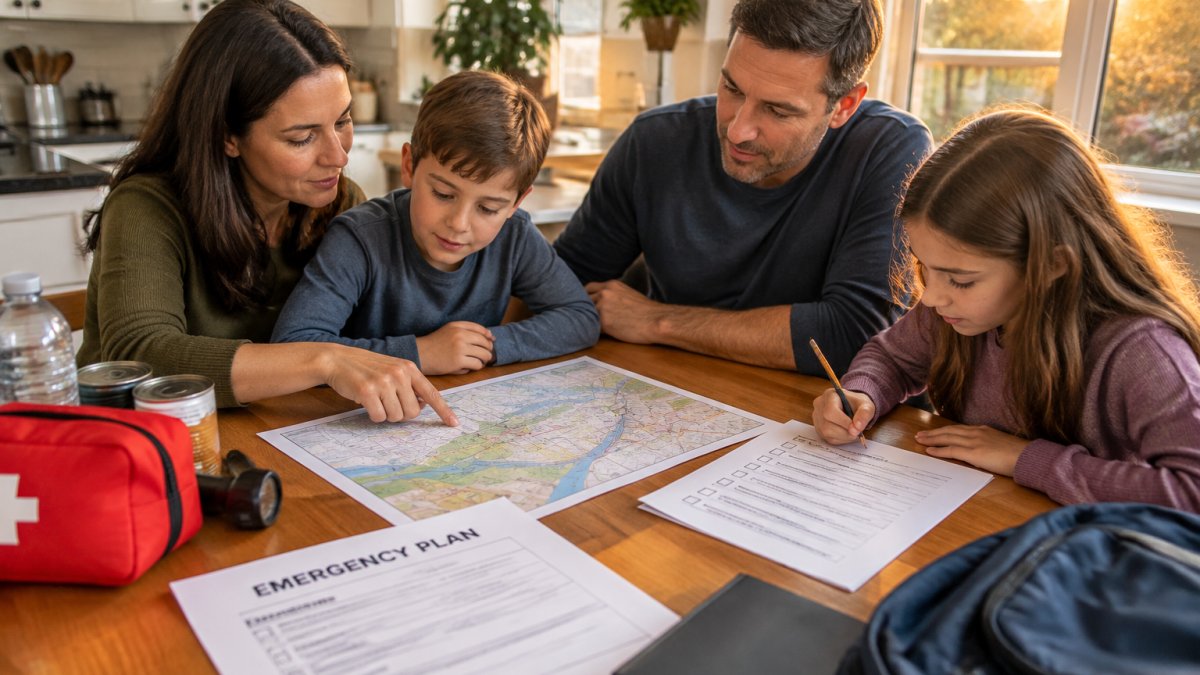
Disaster preparedness training for families works best as a short, sequenced curriculum rather than a single session. Four weeks, one hour per week, is enough to move a household from unready to tested.
Week by Week: Drills, Roles and Readiness Checks
| Week | Focus | Drill | Readiness Check |
|---|---|---|---|
| 1 | Communication plan | Call tree test | Every member recites two contacts |
| 2 | Emergency supply kit | Timed kit grab | Kit covers 72 hours for all members |
| 3 | Evacuation routes | Walk both routes | Routes walked in under 10 minutes |
| 4 | Shelter in place | Seal one room | Room sealed in under 15 minutes |
Keep each session short. End every week with the same question: what failed, and what do we fix first?
Where to Get a Family Emergency Plan PDF (and How to Vet It)
A family emergency plan PDF is only as good as its source. Government and nonprofit publishers produce the most reliable versions, and they are free.
Vet any PDF with this checklist:
- Published by a recognized agency or nonprofit
- Dated within the last few years
- Includes a communication plan and meeting places
- Covers people with disabilities and access needs
- Has a fillable format, not just advice text
Avoid undated PDFs from unknown sites, since emergency guidance changes.
Hazard-Specific Training: Earthquakes, Floods, Fires and Lockdowns
Hazard-specific training teaches the one or two actions that differ by disaster. Generic preparedness gets you partway. The rest is knowing which move applies, how long it takes, and what to practice until it is automatic.
Run one drill per hazard per year, and time each drill so you can compare results. A drill that is not timed is a rehearsal, not a test.
Earthquake: Drop, Cover, Hold On
Practice dropping under a sturdy table, covering your head and neck, and holding on for at least 60 seconds. Do not run outside during shaking. After the drill, identify one heavy item in each room that could fall and secure it.
Watch out: families often practice the drop but forget to identify a second safe spot in rooms without a table, so assign one before the next drill.
Flood: Move to Higher Ground, Never Drive Through Water
Walk your family through the route to the highest floor or nearest high ground, and mark it on your plan. Practice the rule "turn around, don't drown" out loud. Time how long it takes everyone to reach the upper floor.
Fire: Get Out Fast, Stay Out, Call from Outside
Run a fire drill from each bedroom, using two exits where possible. Practice feeling the door for heat before opening it, and crawling low under smoke. Set a meeting place outside and time the full evacuation.
Lockdown: Lock, Lights Off, Silence Phones
Practice moving to an interior room, locking the door, turning off lights, and silencing phones. Time how long it takes to get everyone silent and out of sight. Assign one adult to check the room and one to monitor official alerts.
Household-Specific Decision Points
Hazard training should account for your household. Renters may not be able to secure heavy furniture, so identify safe spots instead. Rural households need longer evacuation timelines and a plan for pets and livestock. Multigenerational families should assign one adult to help children and one to assist older relatives. Households with limited transportation should identify a neighbor or ride-share contact before a hazard.
Our severe weather preparedness hub turns watches, warnings, and local orders into clear household actions for storms, floods, wildfire smoke, and heat.
Adapting Training for Children, Older Adults and Access Needs
Training must fit the household, not the other way around. Children learn through games and repetition, older adults often need medication plans and mobility checks built in, and people with disabilities need adaptations that are practiced, not assumed. The competitive gap here is practical adaptation: most resources mention access needs but do not show how to integrate them into drills.
Children: Age-Appropriate Activities
For ages 3 to 6, use picture cards and a simple song to teach two emergency contacts and the meeting place. For ages 7 to 12, turn drills into timed games and let children carry their own flashlight and shoes. For teens, assign a real role such as checking the kit or texting the out-of-area contact.
Watch out: children may freeze if a drill is too realistic, so announce practice drills clearly and debrief afterward.
Older Adults: Medication and Mobility
Build a medical care plan with a medication list, dosages, and prescriber contacts. Practice moving to the meeting place at the pace the person can sustain, and identify a seated rest point on the route. Households supporting aging parents can follow disaster planning for elderly parents for a step-by-step walkthrough. Include a backup plan for power-dependent medical equipment.
Access and Functional Needs: Sensory, Cognitive, Mobility, Language, and Literacy
For sensory needs, offer written and visual instructions alongside spoken ones, and practice drills with noise-canceling headphones if loud alarms cause distress. For cognitive needs, break each drill into one step at a time and repeat monthly. For mobility needs, walk the evacuation route with the actual mobility device and identify a second exit. For language and literacy needs, use plain-language materials and translated versions where available, and confirm understanding by having each person explain the plan back in their own words.
Multilingual and Low-Literacy Materials
Prepare a one-page visual plan with icons for meeting places, contacts, and kit location, and practice pointing to it during drills. Keep a translated copy of the emergency contact list in the kit.
Debrief and Maintenance
After every drill, ask three questions: what failed, who struggled, and what adaptation is needed. Update the plan after household changes such as a new baby, a new medication, or a move. Review contacts and supplies every six months, and revise the plan after any local hazard update.
Run Your Readiness Diagnostic and Fix the Top Gap First
A readiness diagnostic scores your household across plan, kit, communication, and drills, then ranks your gaps. Fix the biggest one first. Do not try to fix everything at once.
Score yourself on this simple scale:
- Plan: written and tested? Yes or no
- Kit: 72 hours of supplies for everyone? Yes or no
- Contacts: two out-of-area names memorized? Yes or no
- Drills: one practiced in the last six months? Yes or no
If you are starting from zero, start here with four calm, practical steps.
Most households know they should prepare and still do not, because the advice arrives as a pile instead of a path. FlintReady fixes that with a three-minute readiness diagnostic, live national threat monitoring, and field guides built for real budgets. We built these tools as a former U.S. Army Geospatial Engineer, so they favor tested procedure over gear lists.
Frequently Asked Questions
What should a family emergency plan include?
At minimum: an emergency communication plan with two out-of-area contacts, a meeting place inside and outside the neighborhood, evacuation routes from your home, a shelter-in-place procedure, and a list of medications and important documents. Ready.gov offers a fillable family emergency-plan form you can adapt.
How often should a family practice an emergency plan?
Run a short drill every quarter and a full review twice a year. Quarterly drills can be as simple as a two-minute meeting-place walk or a fire drill from each bedroom. The twice-yearly review should update emergency contacts, check expiration dates on supplies, and confirm that children know how to call for help. Testing matters, because gaps often stay hidden until a real event.
How can children be included in disaster preparedness training?
Use age-appropriate activities rather than scare tactics. Younger children can practice dialing emergency contacts and finding the meeting place; older children can take on a role such as grabbing the go-bag or checking the water supply. Keep sessions short, repeat them, and let children ask questions without alarming them.
Where can I find a family emergency plan PDF?
Before you commit to any family emergency plan PDF, check who produced it, whether it covers hazard-specific planning for your region, and whether it includes a review schedule. A PDF you never open is worth less than a one-page plan you test every quarter, so pick one you will actually use.
