How to Build a Family Disaster Plan That Works
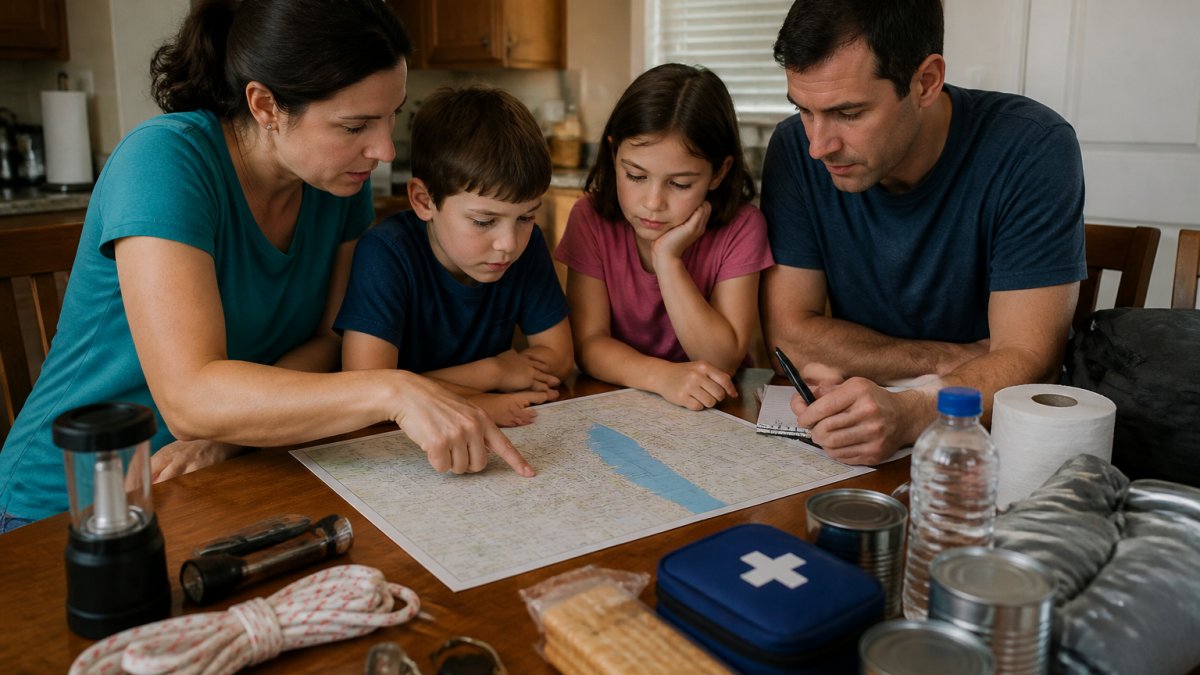
Table of Contents
- Why Every Household Needs a Family Disaster Plan
- Identify Local Hazards and Assess Your Household Risks
- How to Create a Family Emergency Communication Plan
- Use a Family Emergency Plan Template to Document Roles
- Build a Disaster Evacuation Plan for Families
- Your Family Emergency Kit Checklist for Home and Go-Bags
- Plan for Specific Needs: Medications, Disabilities, and Pets
- Practice, Review, and Maintain Your Family Disaster Plan
- Frequently Asked Questions
Last Updated: October 14, 2026
Why Every Household Needs a Family Disaster Plan
A family disaster plan is a written, practiced set of instructions telling every household member what to do, where to go, and how to reach each other when routines break down.
Most households assume emergency services will come, schools will call, and the power will return.
The 8 steps below build a plan from scratch, including the parts most guides skip: medications, accessibility needs, pets, and keeping the plan alive after you write it.
Identify Local Hazards and Assess Your Household Risks
Start with what is actually likely where you live, not a generic list of every disaster imaginable.
Rank your top three hazards by likelihood and warning time. A tornado gives minutes; a hurricane gives days. That difference changes your entire plan.
Then walk your home room by room and answer three questions:
- Where would we shelter for each hazard on our list?
- What in this room fails first if the power goes out for a week?
- Who in this household cannot evacuate without help?
A common mistake is planning for the dramatic scenario and ignoring the boring one. Extended power outages and severe storms disrupt far more households than the events that make national news.
How to Create a Family Emergency Communication Plan
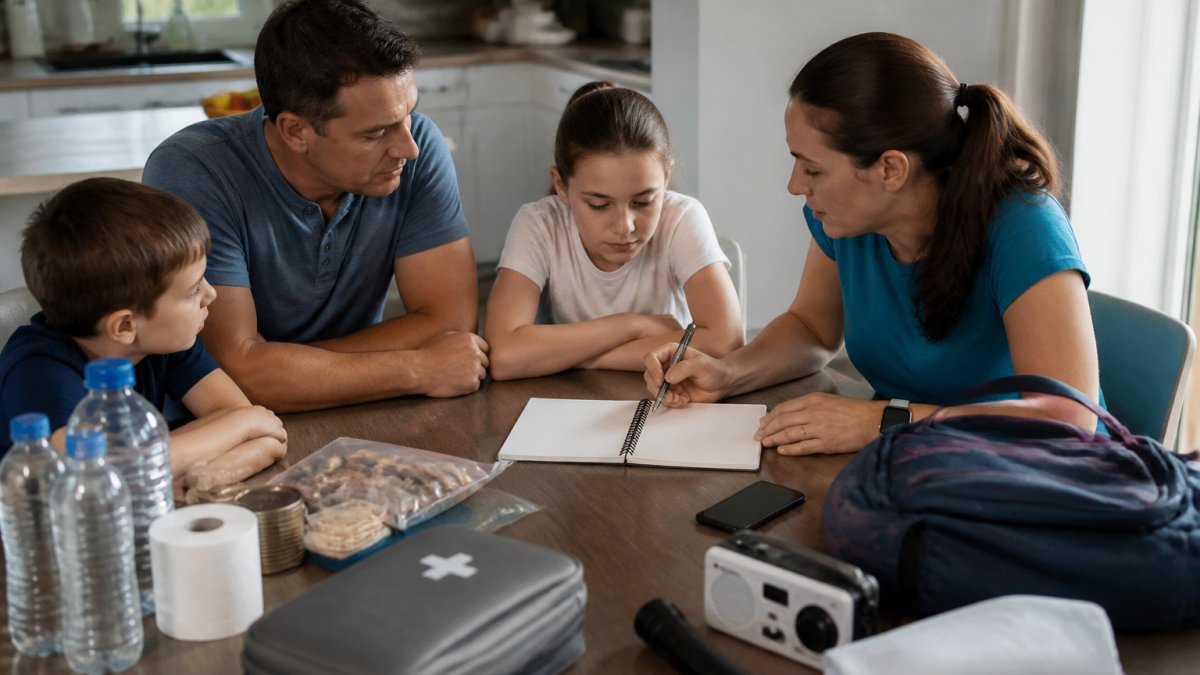
A family emergency communication plan is one document listing every household member's phone number, workplace or school address, and a shared out-of-area contact who can relay messages when local networks are overloaded.
Here is how to build it in one sitting:
- List every household member with phone number, daily location, and typical hours.
- Choose one out-of-area contact, long-distance calls often connect when local circuits are jammed.
- Give every family member that number on a physical card, not just in a phone.
- Agree on a check-in window: everyone reports in within 15 minutes of a triggering event, or as soon as it is safe.
- Decide what "safe" means. If you can't reach anyone, where do you go?
Text before you call. During a regional event, texts route through congested networks more reliably than voice calls.
Use a Family Emergency Plan Template to Document Roles
A family emergency plan template turns your decisions into a document with names attached to tasks.
Cover these roles at minimum:
- Who calls for help and stays on the line with emergency services
- Who handles the children and gets them to the meeting place
- Who shuts off utilities if instructed by officials
Write the plan on one page if you can. Two pages maximum. A plan nobody can find or read under stress is not a plan.
Include a household roster with names, ages, medical notes, and current medications. Keep one copy in the home, one in each vehicle, and one with your out-of-area contact.
Build a Disaster Evacuation Plan for Families
Start with hazard-specific evacuation triggers. The same household evacuates differently depending on what is happening:
- Wildfire: Leave early, before an official order, if you are in a high-risk zone and smoke or wind is worsening. Take the route away from the fire's direction of travel, not the shortest route to your destination.
- Flood: Never drive through standing or moving water, six inches can knock an adult down and one foot can float most cars. If your primary route crosses a low-water crossing or creek, default to the higher-ground route.
- Hurricane: You usually have days of warning. Leave before contraflow and fuel shortages begin. If you shelter in place instead, your evacuation plan becomes a shelter-in-place plan, different supplies, different location in the home.
Write the trigger for each of your top three hazards on the plan itself.
Map routes, then map backups for the backups. Map at least two routes out of your neighborhood.
Then stress-test each route against realistic failure modes:
- What if the primary route is blocked by debris, a downed line, or an emergency closure?
- What if the secondary route is gridlocked because every other family chose it too?
- What if you have to leave on foot because roads are impassable?
Decide on two meeting places and one fallback.
| Meeting Place | Location | When to Use It |
|---|---|---|
| Neighborhood meeting point | End of your street or a nearby landmark | Home is unsafe but the area is fine |
| Evacuation location | A specific address outside your neighborhood | Area-wide evacuation order |
| Fallback location | A second address farther out, or a shelter site | Primary evacuation location is unreachable or full |
Give every household member all three addresses in writing.
Plan the vehicle logistics before you need them.
- Keep your gas tank at least half full. During a regional event, fuel stations lose power and run dry within hours.
- With one vehicle and multiple adults, agree in advance who drives, who is picked up where, and who is responsible for which children.
- Store a small go-bag in each vehicle's trunk, not just the house. If you evacuate from work or school, the vehicle kit may be all you have.
Practice the drive to your evacuation location at least once a year, on a normal day, plus the alternate route.
Your Family Emergency Kit Checklist for Home and Go-Bags
A family emergency kit checklist covers two separate kits: a home supply kit built for staying put at least two weeks, and a go-bag per person built for leaving in five minutes.
Home kit essentials:
- Drinking water, one gallon per person per day for two weeks
- Non-perishable food for two weeks, plus a manual can opener
- Flashlight and batteries for each room
Go-bag per person:
- Three days of water and food
- One change of clothing and sturdy shoes
- Copies of IDs and contact information
For apartment dwellers, space is the constraint. Store water in stackable containers under beds and behind furniture, and use closet vertical space. Buy one extra item per grocery trip until the kit is complete.
Plan for Specific Needs: Medications, Disabilities, and Pets
Generic plans fail households with specific needs, where failure costs the most. Most guides mention medications, disabilities, and pets in a single bullet, a reminder, not a plan.
Medications and medical continuity.
- Keep a written list of every prescription, dosage, prescribing doctor, and pharmacy with phone numbers. Store one copy in the go-bag, one in the home kit, and one with your out-of-area contact.
- Ask your pharmacist about an emergency refill or vacation override. Many insurers and pharmacies allow an early refill before a forecasted event; rules vary, so ask before you need it.
- Rotate a two-week supply through your go-bag. Set a calendar reminder to replace anything expiring within 90 days.
Medical equipment and backup power.
If anyone depends on powered equipment, oxygen concentrators, CPAP machines, dialysis, refrigerated medication, power wheelchairs, do the math before the outage:
- How many hours does the device run on its internal battery?
- How many hours must you bridge until power returns or you reach a powered location?
- What is your backup? A portable battery bank sized to the device, a car inverter, or a planned relocation.
Register with your utility's medical baseline or life-support program and your local emergency management office's special needs registry.
Accessibility and evacuation assistance.
- Identify who can evacuate without assistance and who cannot. Assign a specific person to each household member who needs help, plus a backup if the helper is not home.
- Practice the actual evacuation with the actual mobility aids. A wheelchair that fits through the front door may not fit a secondary exit, and a stairwell that works normally may not work if the elevator is out.
- For a household member who is deaf or hard of hearing, plan how they receive alerts: a weather radio with visual alerts, a phone with vibration and flashing alerts, and a neighbor who will knock.
Pets.
Most emergency shelters do not accept animals, so identify pet-friendly shelters, hotels, or boarding options on your evacuation route in advance.
Practice, Review, and Maintain Your Family Disaster Plan
An unrehearsed plan is a document, not a capability. Run a full household drill twice a year, treating the first as a diagnostic rather than a test.
Run the drill in two parts: a tabletop run-through to confirm roles and contact numbers, then a live drill practicing evacuation to your neighborhood meeting point and the shelter-in-place procedure for your top hazard.
After each drill, update the plan with what broke, a changed phone number, missing go-bag batteries, a sticking stairwell door.
Set a recurring calendar reminder for these maintenance tasks:
- Every 6 months: full drill and plan review
- Every 6 months: rotate water, food, and medications in both kits
- Annually: verify contact numbers, school and workplace procedures, and evacuation routes
Frequently Asked Questions
What is a family disaster preparedness plan?
A family disaster preparedness plan is a written document that outlines how your household will respond to emergencies. It covers communication methods, meeting places, evacuation routes, shelter-in-place procedures, and supply kits. The plan assigns specific roles to each household member, including children and older adults, so everyone knows what to do without hesitation. It should also account for pets, medications, and accessibility needs. Review and practice the plan at least twice a year to keep it current.
What are the key elements of a disaster plan?
A complete family disaster plan includes five core elements: a communication strategy with an out-of-area contact, two meeting places (one near home and one outside your neighborhood), evacuation routes and transportation arrangements, shelter-in-place instructions for different hazards, and a family emergency kit checklist. It should also identify local hazards, assign roles to household members, and include copies of important documents. Practice drills and regular updates keep the plan functional.
How do you choose family meeting places for an emergency?
Choose two meeting places. The first should be immediately outside your home, like a specific tree or mailbox, for sudden events like a fire. The second should be outside your neighborhood, such as a library or community center, in case you cannot return home. Make sure every household member can identify both locations and knows how to get there on foot or by public transport. Practice walking or driving the routes together.
How should families communicate if they are separated during a disaster?
Text messages often get through when calls do not. Establish a family emergency communication plan that includes texting first, then calling if possible. Choose an out-of-area contact, like a relative in another state, who can relay messages between separated family members. Keep a written contact list in every bag and wallet. Teach children how to use a phone to reach the out-of-area contact, and practice this during drills.
How often should a family disaster plan be reviewed and practiced?
Review your family disaster plan every six months and after any major life change, such as a new baby, a move, or a change in school or work schedules. Practice drills at least twice a year. Use these sessions to test communication methods, walk evacuation routes, and check that emergency kits are fully stocked and medications are not expired. Update contact information and meeting places as needed.
What should go in a family emergency kit?
A family emergency kit checklist should include at least three days of non-perishable food and one gallon of water per person per day, a first-aid kit, medications, a flashlight, batteries, a battery-powered or hand-crank radio, important documents in waterproof bags, and clothing. Add items for children, older adults, and pets. Store a smaller go-bag in each vehicle and at work or school. Check expiration dates every six months.
Most households never build a plan because the task feels enormous and the gear lists feel expensive. It isn't, and it doesn't have to be. FlintReady was built by a former U.S. Army Geospatial Engineer specifically to replace fear-driven preparedness with a calm, operational process: a three-minute readiness diagnostic, a prioritized fix list, and field guides for the disasters you are actually likely to face. Take the 3-minute scan and find out exactly where your household stands.