Disaster Planning for Elderly Parents: A Step-by-Step Guide

Table of Contents
- Start With a Conversation, Not a Checklist
- Build a Family Communication Plan and Emergency Contact List
- Assemble an Emergency Kit for Seniors
- Create a Medical Information Sheet for Emergencies
- Power Outage Preparation for Seniors and Medical Equipment
- Build a Senior Evacuation Plan That Accounts for Mobility
- Coordinate Caregivers Across Distance and Relatives
- Conclusion
- Frequently Asked Questions
Last Updated: October 19, 2026
Start With a Conversation, Not a Checklist
Disaster planning for elderly parents starts with a conversation, not a supply list. The most common mistake we see is adult children buying a kit first and talking to their parent last. A plan built around assumptions about what your parent can or will do rarely survives contact with reality.
Before anything else, sit down and ask three questions: What worries you most? What would you refuse to leave behind? Who would you call first? The answers shape everything that follows, from the size of the emergency kit for seniors to whether a senior evacuation plan is realistic.
A parent who resists "prepping" will often still engage with a practical question about a storm or a power cut. Keep it concrete and avoid fear.
Write the answers down. That single page becomes the base of your disaster plan, and it's the first item in the printable plan we build through this guide.
Build a Family Communication Plan and Emergency Contact List
A family communication plan is a written set of names, numbers, and check-in rules everyone understands before a disaster hits. It answers one question: who calls whom, and when?
Start with an out-of-area contact. Local phone lines often fail during storms and floods, but long-distance calls frequently still get through.
Then set the rules:
- A group text for routine updates
- A phone call if no reply within a set number of hours
- A physical card in your parent's wallet with the same numbers
- A note on the fridge with the out-of-area contact in large print
Keep emergency contacts accessible in three places: a paper card, a phone entry labeled "ICE" (in case of emergency), and a printed sheet by the landline if your parent still has one. Paper matters. Batteries die and screens crack.
The Federal Emergency Management Agency's family communication planning guidance outlines a similar structure and is worth reading together with your parent.
Assemble an Emergency Kit for Seniors
An emergency kit for seniors is a portable supply set sized to one person's medical, mobility, and dietary needs, designed to last at least several days without help.
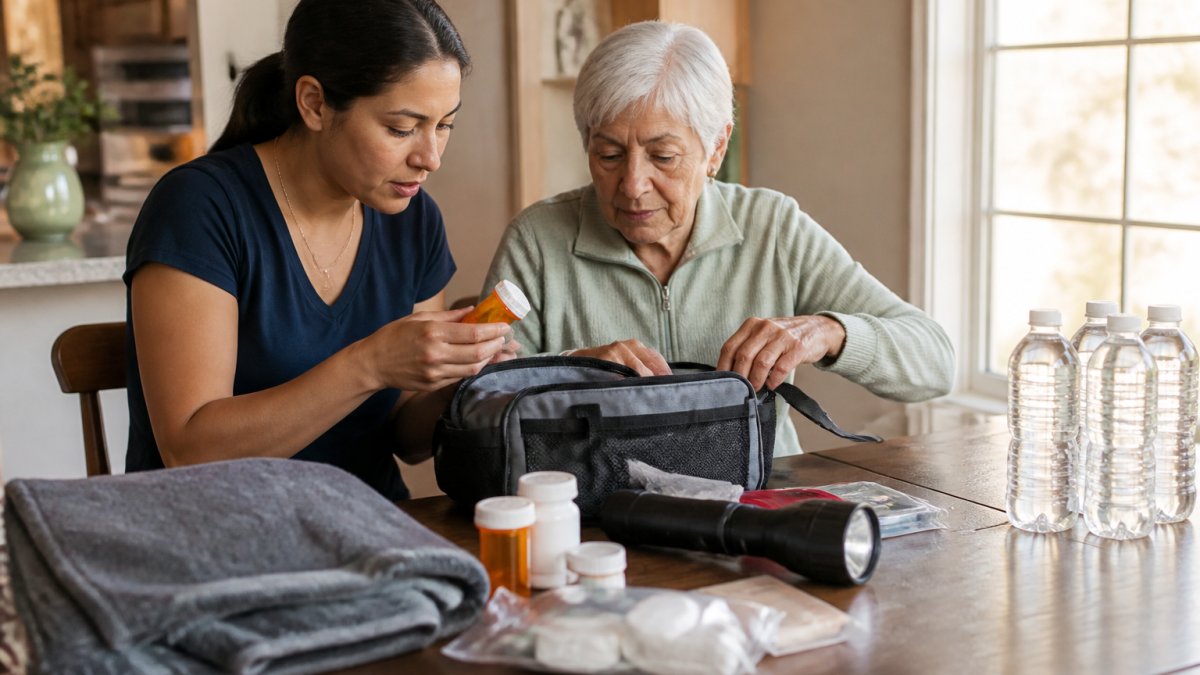
Build it around a small rolling bag or a backpack your parent can actually lift. If they use a walker or wheelchair, choose a bag that hangs on the frame.
Pack these essentials:
- Seven days of medications in a labeled pill organizer, plus a written prescription list
- Water and easy-to-open food, including any dietary or dental restrictions
- A flashlight, spare batteries, and a battery or hand-crank radio
- Hearing aid batteries, glasses, and a spare pair
- Assistive devices: cane, spare charger for a mobility scooter, incontinence supplies
- Warm layer, sturdy shoes, and a small amount of cash
Check the kit every six months. Medications expire, batteries leak, and food goes stale. Put a reminder in your phone for the same two dates each year.
Create a Medical Information Sheet for Emergencies
A medical information sheet for emergencies is a one-page document listing your parent's conditions, medications, allergies, doctors, and care preferences. First responders and shelter staff need it in seconds, not after a phone call to you.
Make it short and printable. Include:
- Full name, date of birth, and address
- Diagnoses and current health conditions
- Every medication with dose and schedule
- Allergies and adverse reactions
- Primary doctor, pharmacy, and insurance information
- Mobility limitations and assistive devices used
- Emergency contacts and an out-of-area contact
- A short note on cognitive status and how your parent communicates best
Print several copies: one in the emergency kit, one in the glove box, one in your parent's wallet, and one on the fridge, laminated or sealed in a plastic sleeve.
Store a digital copy too, in a shared folder you and any siblings can reach. If your parent has a service animal, add its details and vaccination record to the same sheet.
Power Outage Preparation for Seniors and Medical Equipment
Power outage preparation for seniors comes down to one question: what stops working when the electricity does? For some households it's lights and heat; for others it's oxygen, a hospital bed, or a refrigerator holding insulin.
Start with a device inventory.
That wattage number turns a vague worry into a plan. A portable power station rated for 1,000 watt-hours runs a 100-watt device for roughly ten hours, less after inverter losses; a 300-watt concentrator drains it in about three hours.
Work through the backup options in this order:
- Talk to the equipment supplier first. Oxygen and ventilator suppliers often provide a backup cylinder or battery as part of the rental, and they can tell you the expected runtime. Ask what the supplier's own emergency protocol is.
- Register with your utility's medical priority program where one exists. These programs flag the address so restoration crews know a life-sustaining device is present. Registration does not guarantee priority, but it improves the odds and is free.
- Size a battery to the device, not to the room. Match the power station's continuous output to the device's draw and its capacity to the hours you need to bridge. Check whether the device needs pure sine wave output; some medical equipment does.
- Keep a printed relocation plan. Identify a powered location within driving distance, a relative's home, a shelter with generator power, or a medical facility, and write down the trigger for going there.
Refrigeration deserves its own line item. Insulin generally needs to stay cool but not frozen, and most manufacturers publish a room-temperature window (often around 28 days) during which an unrefrigerated pen is still usable, check the product insert rather than guessing. For other refrigerated medications, a small cooler with frozen gel packs and a thermometer will usually bridge a short outage; keep the fridge and freezer closed to preserve cold.
Heat and cold are the other half of the equation. Older adults lose body heat faster, and a winter outage in an apartment can turn dangerous within hours.
Finally, test the plan before you need it. Unplug the device for a few minutes and confirm the backup actually powers it. A battery that has never been load-tested is a guess, not a backup.
Build a Senior Evacuation Plan That Accounts for Mobility
A senior evacuation plan is a written route and transport arrangement that matches your parent's actual mobility, not their mobility from ten years ago. Evacuation is where good intentions fail most often.
Work through it in order:
- Pick two exit routes from the home and practice both.
- Decide who transports your parent, and have a backup driver.
- Confirm the vehicle can fit a walker, wheelchair, or scooter.
- Choose a meeting place outside the home and a second one outside the neighborhood.
- Identify a shelter that can handle mobility and medical needs.
- Agree on when to shelter in place instead of leaving.
Shelter in place is the right call for many storms and for most wildfire smoke events. Evacuation is the right call when authorities order it or when a power-dependent device is running out.
If your parent has dementia or another cognitive impairment, add a familiar comfort item to the go-bag and brief any caregiver on how to redirect rather than argue. Confusion rises fast in unfamiliar settings.
Coordinate Caregivers Across Distance and Relatives
Caregiver coordination is the part of disaster planning for elderly parents that quietly decides whether the plan works.
Assign roles in writing. A workable division looks like this:
- Primary decision-maker for medical choices, with a named backup in case they are unreachable
- Transport lead who owns the vehicle, the route, and a backup driver
- Supplies lead who checks the kit twice a year and replaces expired medication
- Communications lead who updates the out-of-area contact and the shared document
- Local eyes, a neighbor, friend, or regular caregiver who can physically check on your parent
Write the roles into one shared document and print a copy for the fridge, updating it whenever medications change or a caregiver leaves.
Distance creates its own risk, and the fix is relationship-building before the event. If you're far away, introduce yourself to the neighbor and regular caregiver now, not during a storm.
During an event, remote family members need a single source of truth. A group text works for routine updates but fragments under stress. A common pattern: the communications lead posts one status update at set intervals, say, every two hours, so the rest of the family stops calling the parent directly and tying up the line. That rule prevents the most common coordination failure: five relatives calling at once and no one getting through.
Backup caregivers deserve explicit planning. Paid caregivers may not reach the home during a storm, and family members may be stranded.
At FlintReady, our live national threat dashboard covers weather, seismic, cyber, and space events in one view, which helps families tracking an address from another city.
Conclusion
The hard part isn't buying supplies. It's getting one parent, their medications, their mobility needs, and several relatives onto the same page before a storm arrives. Most families put that off until the first real warning.
FlintReady is built for exactly this. Our readiness diagnostic gives you a prioritized fix list, our field guides cover power outages and storms in plain steps, and our threat dashboard keeps distant family members watching the same picture. Start with the conversation, then let the tools carry the rest.
Take the 3-minute scan and find out where your parent's plan actually stands.
Frequently Asked Questions
How do you make an emergency plan for elderly parents?
Start by talking with your parent about what they can and cannot do on their own. Write down their medical conditions, medications, and mobility needs, then build a family communication plan with an out-of-area contact and a check-in schedule. Assemble a small emergency kit for seniors, set up power outage preparation for seniors, and practice a senior evacuation plan together. Review the plan every six months and update supplies.
What should be in an emergency kit for an older adult?
An emergency kit for seniors should include a seven-day supply of medications in a labeled pill organizer, a printed medication list, spare glasses and hearing aid batteries, a flashlight, a battery-powered radio, water and easy-to-eat food, and a change of clothes. Add copies of insurance cards and a medical information sheet for emergencies. Keep the kit small enough to grab and go, and check expiration dates twice a year.
How can caregivers prepare for a power outage affecting an elderly parent?
Power outage preparation for seniors starts with listing every device that needs electricity, such as oxygen concentrators, CPAP machines, or stair lifts. Contact the utility company to flag the address as medical-dependent, and buy a backup battery or generator sized to the device. Keep flashlights, blankets, and a charged phone in one spot. Set a check-in call schedule so you know the power is out before your parent does.
How often should an emergency plan for elderly parents be reviewed?
Review the plan every six months and after any major change, such as a new diagnosis, a fall, a move, or a change in caregivers. Check expiration dates on medications and food, update the medical information sheet for emergencies, and confirm phone numbers and out-of-area contacts. A short review twice a year keeps the plan usable when it matters most.